
Bitcoin Halving Explained: What It Means and Why It Matters in 2026
- 377 Views
- DiscoverNews Editorial Team
- August 8, 2024
- Business
In the bitcoin market, the halving of Bitcoin is one of the most important events. It directly affects how new Bitcoins are created, how miners are rewarded, and how supply enters the market.
Unlike traditional currencies that governments can print at any time, Bitcoin follows a fixed and transparent monetary schedule. Halving is the mechanism that enforces this scarcity.
This guide explains:
- What Bitcoin halving is
- Why it happens
- How it impacts price and miners
- What happened in previous halvings
- What investors should realistically expect
Table of Contents
ToggleWhat Is Bitcoin Halving?
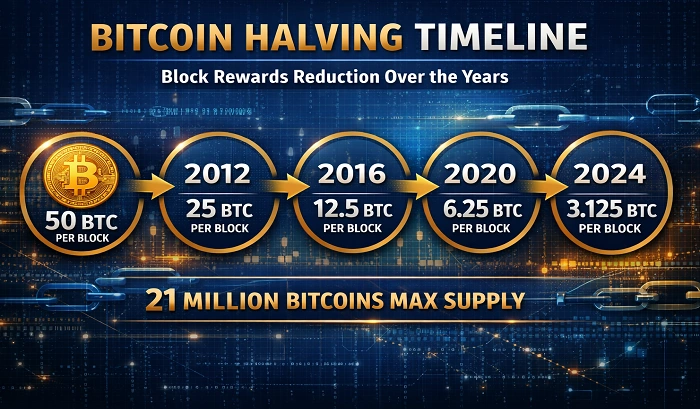
Bitcoin halving is an event that occurs approximately every four years (every 210,000 blocks). During this event, the reward that miners receive for validating transactions is reduced by 50%.
For example:
- 2009 → 50 BTC per block
- 2012 → 25 BTC
- 2016 → 12.5 BTC
- 2020 → 6.25 BTC
- 2024 → 3.125 BTC
This decrease keeps going until the maximum number of Bitcoins, which is 21 million, is attained.
Why Does Bitcoin Halving Exist?
Bitcoin was designed with a limited supply. The goal is to create digital scarcity similar to gold.
Halving ensures:
- Controlled inflation
- Predictable supply schedule
- Long-term scarcity
- Protection from monetary manipulation
Because supply growth slows over time, Bitcoin becomes increasingly scarce.
This scarcity-driven model is also central to decentralized finance platforms, similar to concepts discussed in our article on Coyyn.com Business: Leading the Future of DeFi, where blockchain-based financial systems aim to operate without centralized control.
Historical Bitcoin Halvings and Market Impact
2012 Halving
Rewards dropped from 50 BTC to 25 BTC.
Prices rose significantly over the following year.
2016 Halving
Reward dropped from 25 BTC to 12.5 BTC.
Bitcoin later reached nearly $20,000 in 2017.
2020 Halving
Reward dropped to 6.25 BTC.
Bitcoin reached new highs above $60,000 in 2021.
2024 Halving
Reward was reduced to 3.125 BTC.
The long-term market impact is still developing and depends on macroeconomic conditions and investor demand.
Important: Price increases after halving are not guaranteed. Many external factors influence Bitcoin’s value.
How Halving Affects Bitcoin’s Supply
Bitcoin has a limit of 21 million coins.
That’s because halving slows down the flow of new coins into circulation. Overall, this lowers prices and raises scarcity.
Eventually, around the year 2140, there will be no more Bitcoins released. Buyers and sellers will pay processing fees to miners.
Impact on Bitcoin Miners
When rewards decrease:
- Mining becomes less profitable for inefficient miners
- Competition increases
- Mining operations may consolidate
- Energy efficiency becomes more important
Miners with lower electricity costs and better equipment typically survive post-halving pressure.
Does Bitcoin Halving Always Increase Price?
Historically, prices have risen after halvings. However:
- Markets may price in halving early
- Regulatory changes can impact sentiment
- Global economic conditions influence demand
- Institutional investment trends matter
Halving reduces supply growth, but demand ultimately determines price.
Investors should avoid assuming guaranteed profits.
Economic Significance of Halving
Bitcoin’s monetary policy is fully transparent. Unlike fiat currencies:
- No central bank controls supply
- No emergency money printing
- No political interference
This predictability attracts long-term investors who see Bitcoin as a hedge against inflation.
Risks and Considerations
While halving supports scarcity, risks include:
- Market volatility
- Regulatory uncertainty
- Mining centralization
- Dependence on transaction fees in the future
Cryptocurrency investments remain high risk and highly volatile.
Frequently Asked Questions (FAQ)
How often does Bitcoin halving happen?
Approximately every four years (every 210,000 blocks).
Will Bitcoin price always rise after halving?
No. While previous cycles showed price growth, future performance is not guaranteed.
How many Bitcoins are left to mine?
As of 2026, over 19 million Bitcoins have already been mined, leaving fewer than 2 million remaining.
What happens when there are no more Bitcoins to be mined?
Miners will earn transaction fees instead of block rewards.
Conclusion
Bitcoin halving is a foundational part of Bitcoin’s design. It reduces supply growth, increases scarcity, and shapes long-term market behavior.
While halving can influence price trends, investors should consider broader economic factors and conduct independent research before making financial decisions.
For more insights into blockchain innovation, DeFi platforms, and digital finance developments, explore our latest research on Discover News.
The Discover News Editorial Team publishes original, research-based content across business, digital marketing, home improvement, lifestyle, and general news. Articles are written, edited, and reviewed with a focus on accuracy, clarity, relevance, and reader value, and are intended for general informational purposes only.